
Engine oil plays multiple roles in maintaining a well-functioning vehicle. Primarily, it lubricates various parts to reduce friction and promote longevity, thereby impacting overall performance and fuel efficiency. It also helps prevent corrosion, which can hasten wear and tear on engine components.
Additionally, oil indirectly cools engine parts, cleans the engine by removing impurities, and aids in sealing the combustion chamber. However, the efficiency of these tasks is contingent on the oil’s right viscosity and type, along with a high-quality oil filter.

What Are Oil Filters?
To put it simply, they are critical engine components responsible for purifying the oil. Universally present in all vehicles, these cylindrical-shaped devices are typically attached to the engine block. Their position may vary, located on, under, or adjacent to the block depending on the vehicle.
Although oil filters generally have similar appearances, characterized by a metal outer casing, they differ in terms of the internal filtration media that purify the oil.
It’s crucial to replace the filter when the oil is changed at the recommended intervals, emphasizing the importance of buying the right car oil filters.

What Do They Do?
During combustion, the engine accumulates soot, debris from increased friction and wear, and contaminants such as water, dirt, and coolant. Filters are tasked with removing these impurities before the oil recirculates throughout the engine.
If the oil isn’t sufficiently cleaned due to a defective filter, it can lead to reduced lubrication, compromised combustion efficiency, increased fuel consumption, and elevated emissions.
And if you ever need more info on oil, filters, or general car questions answering head over to carapticon.com.
Essential Parts
To understand the filtration process, first, we must get acquainted with the parts that make up an oil filter. On the outside, there is a metal housing that serves to protect the different interior parts. This includes the tapping plate, the anti-drain back valve, the medium, pleats, a spring retainer, a centre steel tube, a relief valve, and an end disc.
Tapping Plate
The tapping plate is the point of entry and exit for the oil, consisting of small concentric holes to allow the free flow of the oil into the container. This also has a threaded hole that attaches the filter to the engine block.
Anti-Drain Back Valve
This is a rubber valve with a flap that prevents the oil from flowing back into the filter when the engine is off.
Filtering Medium
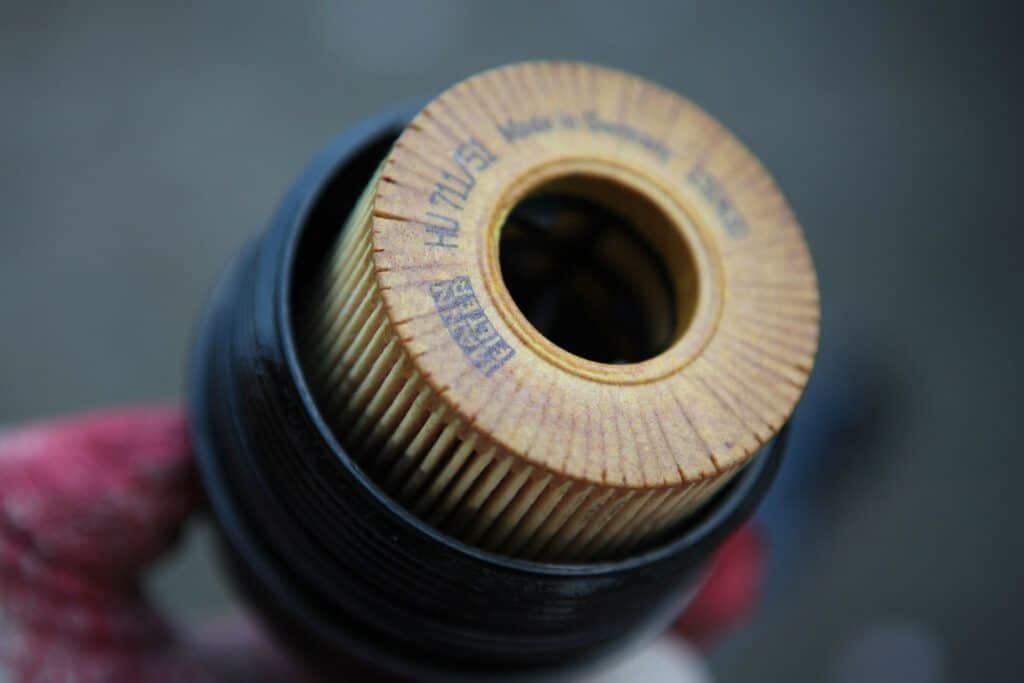
This is a porous surface consisting of cellulose and synthetic fibres such as polyester and glass, as well as pleated paper. The medium is impregnated with resin to increase filtering efficiency and add stiffness and strength. The aim is to capture all contaminants and pollutants in the oil.
Pleats increase the surface area for optimal cleaning. The number of pleats is determined by the medium thickness and how they’re folded, with a higher number offering better oil cleansing. A metal spring retainer tightly secures the filtering medium and end disc against the tapping plate.
Centre Steel Tube
This holds the filtering medium in place and allows unrestricted oil flow. A metal or fibre end tube stops unfiltered oil from leaking into the centre tube. This is located at either end of the medium.
Relief Valve
Since oil viscosity and thickness change with temperature, a relief valve opens when there is not enough pressure to force open the retaining spring and let oil into the medium. The aim is to provide the engine with oil at all times, regardless if it’s cleaned or not, and maintain lubrication. Even if filters are clogged, or the oil pressure is too high, the relief valve ensures that oil will always get to the engine.
The basic operation of purifying dirty oil involves it being pumped under pressure into the filter from the oil sump, through the tapping plate from above. The oil next flows into the medium, through the centre tube, and out into the engine. As mentioned, if there is a clog, the relief valve opens to let unpurified oil through. While not complex, any parts that fail will restrict oil flow and can cause a heap of unwanted issues.
The Different Types
There are several types of filters used in cars today. These include:
- Full-Flow – these are also known as primary filters and are the most common type used today. They’re tasked to clean all the engine oil, so use less restrictive filtering media. They have relief valves as standard, so as to prevent oil starvation, especially on cold starts with high viscosity oil.
- Cartridge – one of the first types of the full-flow variant, allow the filtering media to be replaced without also replacing the housing. Newer designs are spin-on or canister filters with threading and an internal paper element for simple installation and decent filtering.
- Secondary – these are also known as bypass and clean only a small portion of the oil, usually removing remnants that have not been cleansed by the full-flow filter. You’ll often see these in vehicles with diesel engines.
- Subtypes are spinner filters that capture contaminants using centrifugal force with an inner rotating cylinder doing most of the work. Magnetic filters are another secondary type, tasked with capturing metal particles that have been left out by the primary type.

Signs That the Filter Is Bad or Failing
The oil filter in your car will lose its purifying ability over time. This can also be due to it being clogged, or there is damage to the filtering media or other parts. When this happens there are a few telltale signs to look out for.
Poor engine performance can be caused by car oil filters that fail to do their main job and allow for a high amount of particles in the engine. The result is reduced acceleration, even with the gas floored. Clogged filters can lead to sputtering noises due to the build of pressure, while metallic and grinding sounds indicate an increase in parts friction and low oil levels. This can soon lead to complete engine failure.
Other instances to keep an eye on the oil pressure warning lights in the dash, meaning obstructions in oil flow and overheating issues due to clogging, black exhaust smoke with high oil content, and oil leaks under the car.
Typical causes are damage to the filtering media and centre tube, clogging, using filters with the wrong thread size, damage to threads or seals, and overtightening during installation. A large part is also down to where and how you drive, and the miles you’ve done with the same oil and filter in place.

What to Look for in a Replacement
When selecting replacements, ensure the filter fits by paying attention to thread and gasket size. A misfit can cause oil leaks and a loss of oil pressure, leading to potential engine damage.
The type of filtering media, micron size (particle capturing size), and compatibility with your vehicle are other crucial considerations. As a rule of thumb, always replace the oil and oil filter at recommended service intervals to guarantee optimal engine performance and longevity.
There are several choices when it comes to filtering media. More costly options use synthetic fibres or micro-glass, which are usually more efficient than cheaper cellulose variants. The middle ground consists of options with a blend in the filtering medium.
Then, there’s the micron size or the size of the particles the filter can capture. Smaller numbers are often better, meaning higher purifying efficiency, but too low can lead to issues in proper oil flow. Averages of around 40 microns are what you’ll see in most types, as these are a good balance.
In general, filters should match the engine and the oil it requires. Change the oil and the oil filter at the recommended service intervals if you want the best performance from your engine and to make sure it lasts.
