
Every gearhead who wants to add more power to their vehicle knows that the most cost-effective way is by replacing the exhaust system. Replacing the stock pipes for wider, lighter and stronger ones can unlock a lot of performance and efficiency from the engine, while setting the foundations for other modifications down the line. This can completely transform your everyday driving as well as improve your lap times around the track.
Aftermarket exhausts aren’t anything new, by any means, and automotive makers have been experimenting with power delivery, materials and fluid dynamics for many years. However, most of the experimenting was done on track cars.
The first thing that had to go was mild steel, then the design limitations that prevented optimal gas flow, such as crush and wrinkle pipe bending techniques. On top of this, aftermarket exhausts manage to keep up with the latest emission standards and the trend of engine downsizing. So, you get the power and exhaust you want, plus reduced consumption. Win-win-win!

Why Aftermarket Exhausts?
Factory exhaust systems go through a lot of shortcuts in terms of cost-cutting for both design and materials. For these reasons, you get robbed of the full potential of the engine.
As aforementioned, crush and wrinkle bent mild steel exhausts restrict airflow and aren’t as strong. Furthermore, factory exhausts have the tendency for backpressure, which happens when gases make their way back to the cylinder and interfere with the following combustion cycles. The thinner tube walls won’t last long with the extreme temperatures in engines with forced induction engines and engines with bigger displacement. And while your vehicle will be good enough for everyday driving, you can’t expect anything extra.

Remus Exhausts
Remus is one of the first successful aftermarket exhaust companies, which focuses on German cars. It was founded in the 1990s, and has grown significantly in just 3 decades. With over 1000 employees working on the latest aftermarket exhaust technological designs, they manufacture and test exhaust systems for a wide range of vehicles and bikes that are affordable and readily available for a wide range of consumers.
Why Remus? The aftermarket Remus exhausts go through extensive testing for performance, and they sound good. The changes in manifold and header designs deal with the backpressure and enable higher exhaust velocity, which means exhaust gases leave the system faster. Simply put, the quicker the gases leave the vehicle, the more power you get. This is all delivered smoothly, with linear power buildup through the rev range.
The changes in tubing also enable improved efficiency and scavenging with lower fuel use. To top it all off, Remus fine-tunes the exhaust note of their products in a state-of-the-art acoustic room. All of these benefits are reason enough for thousands of car enthusiasts all over the world to upgrade their vehicles with aftermarket Remus exhaust systems.
Materials and Build
All aftermarket Remus systems are built using the mandrel bending technique. This technique takes advantage of a mandrel to support the internal wall of the tubes when they go through the shoe and die. as a result, the tubing is more rigid, and keeps its diameter and profile virtually unchanged, which is important for reducing airflow restriction. Furthermore, the choice of material can greatly impact performance. Stainless steel is more difficult to work with, but it’s much stronger and has superior heat-resistant properties. On top of this, it’s completely rust-proof.
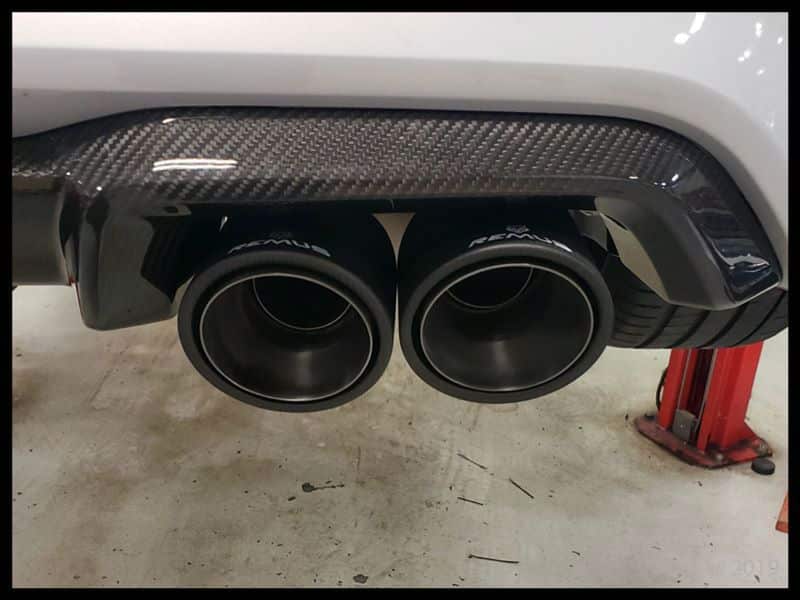
Many people are skeptical about stainless steel due to its look, but Remus has that figured out as well. They add chrome, providing a polished, neat finish. To reduce the overall weight of the exhaust system and add more strength, they use carbon (in the tailpipes). Even the clamps and mounting brackets are made using high-quality, coated stainless steel.
Exhaust Types and Configurations
Remus provides a wide range of exhaust systems to choose from. Most buyers are satisfied with the look and sound of axle-back exhausts. However, those who want to get performance gains go for cat-back exhausts. There are multiple variations of these exhausts, such as DPF-back exhausts for diesels and GPF-back for direct injection petrols. If you’re only driving o the track, look for high-flow cat systems or converter-delete systems with straight and wide tubing.
Additionally, different resonators and mufflers are used together with electronic valve systems to create different exhaust sound profiles. So, if you want your car’s engine to truly “express” itself and showcase its power, you can get a resonated exhaust. Of course, it all comes at a price.
To get the most performance, though, you’ll want a header-back exhaust. In these systems, the downpipes and manifolds are manufactured for optimal airflow, and the entire stock tubing is replaced, down to the tips. These systems also provide superior turbo performance and reduced turbo lag. Experts estimate that on average, you get 5-10% more horsepower and torque. This is enough to provide the extra push when operating on the highway or running the track.
The configurations can vary from car to car, and depend on factors such as turbo and cylinder count and output. Single exhausts are generally reserved for smaller displacement 3- or 4-cylinder engines that end with a single or dual exhaust tip. Dual exhausts, on the other hand, are used in turbocharged 4-pots, as well as 6- and 8-cylinder vehicles. Cars with twin-turbos feature two sets of downpipes and headers that then flow into a single midsection, but have twin-tail pipes.
You’ll also find crossover exhaust systems with intertwining sections that assist with exhaust scavenging and allow for better combustion for cylinders firing at different times. While these changes may not seem significant from what you had as stock, they’re more than noticeable when you place your foot on the accelerator pedal.
All of the aforementioned systems are bolt-on, allowing you to start out as small as you like, and work your way up. To ensure peace of mind, all Remus exhausts come with a 3-year warranty, so you can rest assured that your hard-earned money is well-spent on a quality product that will probably outlast your vehicle.

