
You’ve bought a trailer, borrowed a mate’s caravan or picked up a bike rack, and you’re ready to go. Then you look at the plug, look at the socket on your car and realise they don’t match. It happens to a lot of people, and it’s one of the most common sources of confusion for anyone who tows.
The short version is that there are two main types of towing plug in the UK: the older 7-pin and the newer 13-pin. They do a similar job, but they aren’t the same, and knowing the difference saves you a lot of hassle at the side of the road.
What this guide covers
In this guide, I’ll explain why there are two types of plug, what each one does, how they compare and when an adapter is fine and when it lets you down. I’ll also cover what modern cars need from their towing electrics and how to check that everything works before you set off. No technical background needed.
Why there are two types of plug
For decades, the round 7-pin plug was the standard in the UK. It handled the lights on a trailer perfectly well, but caravans needed more than lights. They needed power for the fridge and for charging the caravan’s leisure battery while on the move. The answer at the time was a second 7-pin socket, which meant two plugs, two cables and twice as many places for something to go wrong.
The 13-pin plug was designed to put everything into a single connector. UK caravan makers switched over to it around 2008, and most new cars with a factory or dealer-fitted towbar now come with a 13-pin socket as standard. That’s why so many drivers end up with a mix of old and new equipment.
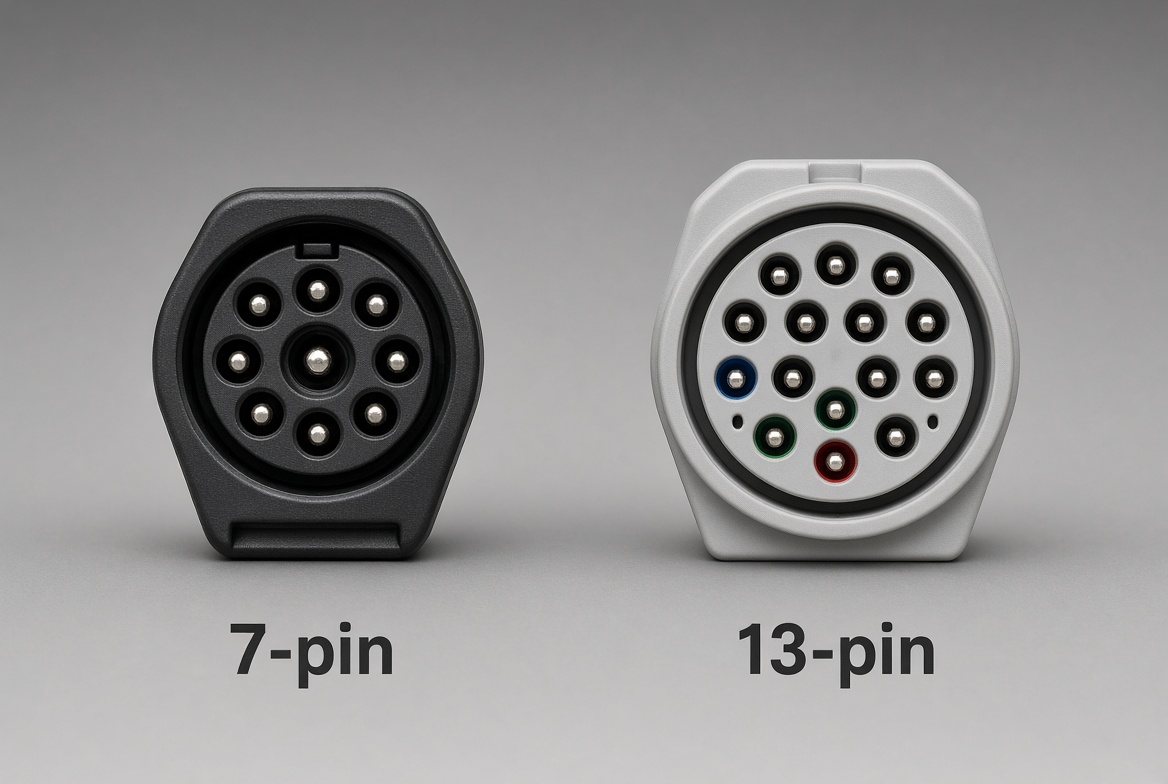
The 7-pin plug explained
12N: the lighting plug
The standard 7-pin plug is known as 12N, where the N stands for ‘normal’. It’s usually black and carries everything a trailer needs to be legal on the road: both indicators, the tail lights, the brake lights, the rear fog light and the number plate light. All of those circuits share a single earth wire.
You’ll still find 12N plugs on plenty of trailers, horse trailers and bike racks, and there’s nothing wrong with that. As long as the plug and socket are in good condition, a 7-pin setup works perfectly for lighting.
12S: the supplementary plug
Caravans built before the switch to 13-pin often have a second 7-pin plug, called 12S, where the S stands for ‘supplementary’. It’s usually white or grey and carries the extras: the reversing light, a permanent power feed for the caravan and a feed for the fridge that only works while the engine is running.
The catch with older sockets is that they wear out. Pins corrode, springs weaken and plastic housings crack after years of rain and road salt. If you need a replacement, it’s worth matching the original part exactly. Erich Jaeger is a well-known German maker of trailer plugs, sockets and adapters, and if your old part carries one of its part numbers, looking it up in an Erich Jaeger catalogue is the quickest way to find the exact replacement rather than something that only looks similar.
The 13-pin plug explained
The 13-pin plug does the job of both 7-pin plugs in a single connector. It carries all the road lights, a reversing light, a permanent power feed and an ignition-switched power feed for things like a caravan fridge. One pin is left spare and isn’t used on most setups.
One of the biggest improvements is the earthing. Instead of one shared earth, the 13-pin plug has three: one for the lighting circuits and one each for the two power feeds. That keeps the heavier caravan loads separate from the lights, which makes strange lighting faults far less likely.
The plug is also easier to use. You push it into the socket and turn it to lock it in place, so it’s much harder for it to work loose on a bumpy road.
7-pin vs 13-pin at a glance
If you just want the key differences side by side, this table sums them up.
| Feature | 7-pin (12N) | 13-pin |
|---|---|---|
| Usually found on | Older cars, trailers and bike racks | Most cars and caravans built since the late 2000s |
| Road lights | Yes | Yes |
| Reversing light | No | Yes |
| Power for a caravan | No, this needed a second 12S socket | Yes, both permanent and ignition-switched |
| Earth connections | One shared earth | Three separate earths |
| How the plug stays in | Held by a catch on the socket cover | Push in and turn to lock |
Using adapters: what works and what doesn’t
Adapters are cheap, widely available and usually do the job. But they don’t add anything that isn’t already there, so it’s important to understand what you lose when you use one.
A 13-pin car with a 7-pin trailer
This is the easy one. A short 13-pin to 7-pin adapter gives your trailer everything it needs, because all the 7-pin lighting functions are already present in the 13-pin socket. For a simple box trailer, a horse trailer or an older bike rack, this works fine.
A 7-pin car with a 13-pin caravan or trailer
This is where people get caught out. If your car only has a single 12N socket, a 7-pin to 13-pin adapter will make the road lights work, but that’s it. You won’t have a reversing light, and the caravan won’t get any power for the fridge or for charging its battery.
If your car has both a 12N and a 12S socket, you can use a twin adapter that combines the two into a 13-pin socket, which gives you most of the functions back. The longer-term solution is to upgrade the car to a 13-pin socket, especially if you tow a caravan regularly.
Modern cars and towing electrics
On older cars, fitting towing electrics was mostly a case of connecting the trailer wiring to the rear lights. Modern cars are a different story. Their electronics often need to know when a trailer is attached, so that features such as the parking sensors, the bulb-failure warning and, on some models, trailer stability control can work correctly.
That’s why there are two main types of wiring kit. A universal kit works on many cars and is usually cheaper, but it doesn’t communicate with the car’s electronics. A vehicle-specific kit plugs into the car’s own wiring and, where needed, is coded to the car so that all its towing features work as they should. If your car has trailer stability control or you want the parking sensors to switch off automatically, a vehicle-specific kit is usually the better choice.
Checking it all works before you set off
Whichever plug you use, check the lights every time you hitch up. It only takes a minute. Switch on the ignition, work through the indicators, tail lights, brake lights, fog light and, if you have one, the reversing light. Having someone stand behind the trailer makes this much quicker, but a plug-in socket tester is a handy alternative if you often tow on your own.
Also take a quick look at the plug itself. Green or white deposits on the pins, a cracked housing or a cable that’s chafed through are all signs that something needs replacing. When the trailer isn’t connected, keep the plug off the ground and covered so that water and dirt can’t get in.

Final thoughts
The difference between 7-pin and 13-pin towing electrics isn’t complicated once you know what each plug does. The 7-pin 12N plug handles the lights, the 12S plug adds caravan power, and the 13-pin plug combines the lot with better earthing and a more secure fit. Adapters are fine for lighting, but they can’t create functions your car doesn’t have. Know what your car and your trailer need, keep the plugs in good condition and check everything before you set off, and towing becomes one less thing to worry about.
